Pakistani troops advance into Swat?"s main town
Thursday, June 25, 2009
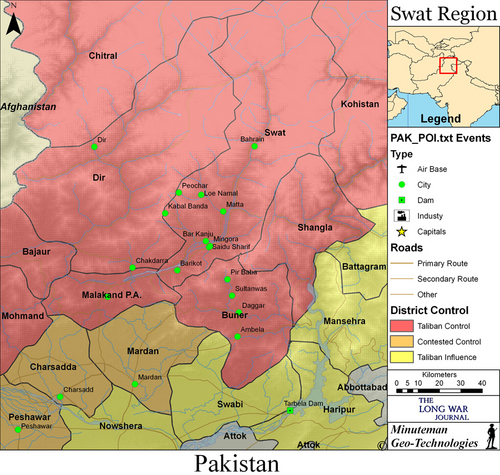 |
| Click map for full view. Taliban presence, by district and tribal agency, in the Swat region. Information on Taliban presence obtained from open source and derived by The Long War Journal based on the presence of Taliban shadow governments, levels of fighting, and reports from the region. Map created by Bill Raymond for The Long War Journal. Last updated: May 12, 2009. |
The Pakistani Army has just made its initial advance into the Taliban stronghold of Mingora, the main town in the insurgency-racked district of Swat. Soldiers appear to have encountered lighter than expected resistance from the Taliban, who were reported to have entrenched in the town and mined the roadways.
Pakistani troops moved into the district?"s main town after securing the Kambar Ridge to the west over the weekend. Five Taliban fighters and three soldiers were reported to have been killed during the opening round of fighting in Mingora, Army spokesman Major General Athar Abbas told Dawn. Fourteen Taliban fighters were captured and six soldiers were wounded during the fighting. Security forces encountered 12 roadside bombs during the advance into the town.
Soldiers seized eight chowks [squares or intersections], in the town, including the notorious Green Chowk, where the Taliban have conducted public executions, including beheadings, and have dumped the bodies of those who opposed Taliban rule.
The Army has linked up with police, paramilitary Frontier Corps troops, and Levies personnel that were holed up in the center of the town during the Taliban siege, according to Abbas. The military has established ?Sa corridor from a suburb to the city centre,? the BBC reported.
Abbas said the military hoped the fighting in Mingora would end in 10 days but said a difficult task in clearing the town still lay ahead.
"Hopefully it will not be more than a week or ten days," Abbas told the BBC. "We have to clear each and every house, we have to search the streets, all those buildings which are not occupied we have to ensure that no explosives or booby-traps are there. It will take some time."
Taliban spokesman and military commander Muslim Khan said forces would remain in Mingora but had been ordered not to fire on Pakistani troops in order to avoid civilian casualties and damaging public property. An estimated 20,000 civilians are still thought to be inside Mingora, while more than 2.2 million Pakistanis overall are said to have fled the fighting in Swat, Dir, Buner, and Shangla.
Fighting has also been reported in the nearby villages of Takhtaband, Garozai, Nawakalay and Shahdara.
In Peochar, the headquarters for the Taliban in Swat, the military said it made its first foray into the northern town since air-assaulting troops there two weeks ago. The military is conducting a cordon and search operation in an effort to flush out the Taliban. A large weapons cache and a roadside bomb factory have been found during the operation.
The military also launched an operation in Malam Jabba and reportedly killed five Taliban fighters.
In addition, the military claimed to have ousted the Taliban from the town of Matta, which is north of Mingora. The Taliban are said to still be in control of the northern regions of Swat, however, including the town of Bahrain, where more than 80,000 civilians are said to be cut off from supplies.
A tactical withdrawal for the Taliban?
As the military moves into Mingora after almost three weeks of heavy fighting, the Taliban may have decided to conduct a tactical withdrawal of its forces, estimated at between 5,000 to 7,000 fighters.
A report from the neighboring district of Buner, where the military is fighting to regain control of the region taken over by the Taliban almost two months ago, indicates that some Taliban units have been ordered to go to ground while others have been ordered to fight and die in a rearguard action designed to bleed the military.
A Taliban fighter going by the name of Ghazan Khan told Deutsche Presse-Agentur that his platoon of 30 fighters was ordered to melt in with the local population fleeing the battlefield, and said some other units have been selected to remain and fight.
?SOur people are giving stiff resistance but you know, the Army has tanks, helicopters and planes,? Khan told DPA. ?STherefore, they have divided Mujahideen in two groups - some will continue the fight and the others will either hide in the mountains or leave the area for a while.?
?SWhen this fight is over and the military regains control in Buner, we will wait for some weeks,? Khan continued. ?SThen we will come back and start a new fight from the mountains.?
The Taliban have practiced this drill several times in the past in Swat , Bajaur, Mohmand, and other areas in the northwest.
The Pakistani military has failed to establish a sufficient cordon to prevent Taliban forces from escaping the battlefields in Swat, Dir, Buner, and Shangla. The military has deployed an estimated 15,000 troops to Swat, many of whom are assigned to force protection details such as base and convoy security and logistical support.
Two weeks after the operation began, Pakistan?"s military leaders discussed moving reinforcements to establish a cordon in the region. But there is little evidence that further units have deployed. Just over a week ago, in Battagram, a district bordering Buner, a Taliban force of about 70 fighters overran a checkpoint that was established to block such movement. The outpost was manned by only four policemen. The Taliban force has set up a safe haven in the region and the military has yet to move to evict them.
Background on the Malakand Accord and fighting in Swat
The fighting in Swat, Dir, Buner, and Shangla broke out after a peace agreement with the Taliban failed. The agreement, known as the Malakand Accord, placed the Malakand Division and the district of Kohistan under the control of the Taliban. The Malakand Division is comprised of the districts of Malakand, Swat, Shangla, Buner, Dir, and Chitral. The Malakand Division and the neighboring Kohistan district together encompass nearly one-third of the Northwest Frontier Province.
The government signed the Malakand Accord with Taliban front man Sufi Mohammed, Fazlullah's father-in-law, on February 16 after two years of fighting that put the Taliban in control of the district. During those two years, the military was defeated three separate times while attempting to wrest control from the Taliban. Each defeat put the Taliban in greater control of the district.
The peace agreement called for the end of military operations in Swat, the end of Taliban operations, and the imposition of sharia, or Islamic law, in the Malakand Division.
But the Taliban violated the agreement immediately after signing it, and proceeded to attack security forces and conduct armed patrols. The military remained silent while the government approved the Taliban?"s demand for sharia throughout Malakand.
After enormous pressure from the US and other Western governments to stem the Taliban tide pushing toward central Pakistan, in late April the Pakistani government ordered a military offensive in Dir and Buner. Earlier in April, the Taliban had advanced from Swat into Buner, taking over the district in eight days. The move into Buner put the Taliban within 60 miles of Islamabad and close to several nuclear facilities and the vital Tarbela Dam. The Taliban also moved into Mansehra and established bases and a training camp in the region.
Pakistani government and military officials have dismissed the Taliban threat to Islamabad and the country's nuclear facilities, but at the end of April, the local Islamabad government ordered troops to deploy in the Margala hills just north of the city to block a Taliban advance, while the Haripur government beefed up security at the Tarbela Dam.
Pakistani troops advance into Swat?"s main town
[Source: Good Times Society]

Pakistani troops advance into Swat?"s main town
[Source: Cnn News]

Pakistani troops advance into Swat?"s main town
[Source: Wb News]
posted by 88879 @ 6:13 PM,
,

ABC News analyst: 50-50 chance that explosion brought down Air France jet from Rio to Paris
 Print
Print Email
Email PDF
PDF John Nance, the former FAA administrator, and now an aviation consultant to ABC News, says that there's a 50-50 chance that the missing Air France jet went down in an explosion. The story was just on ABC. They tended to downplay Nance's comments, but I have to admit, i was wondering about the possibility of terrorism as well. Obviously, it's too soon - and it's suspicious that no terrorist group is claiming credit, since they're usually not very shy about such things.

ABC News analyst: 50-50 chance that explosion brought down Air France jet from Rio to Paris
[Source: Good Times Society - by The American Illuminati]

ABC News analyst: 50-50 chance that explosion brought down Air France jet from Rio to Paris
[Source: Health News]

ABC News analyst: 50-50 chance that explosion brought down Air France jet from Rio to Paris
[Source: News Coverage]
posted by 88879 @ 6:06 PM,
,
THE FUTURE OF MANUFACTURING AND THE AMERICAN WORKER.
PrintEmailPDF What's the administration's specific aim in bailing out GM? I'll give you my theory later.
For now, though, some background. First and most broadly, it doesn't make sense for America to try to maintain or enlarge manufacturing as a portion of the economy. Even if the U.S. were to seal its borders and bar any manufactured goods from coming in from abroad -- something I don't recommend -- we'd still be losing manufacturing jobs. That's mainly because of technology.
When we think of manufacturing jobs, we tend to imagine old-time assembly lines populated by millions of blue-collar workers who had well-paying jobs with good benefits. But that picture no longer describes most manufacturing. I recently toured a U.S. factory containing two employees and 400 computerized robots. The two live people sat in front of computer screens and instructed the robots. In a few years this factory won't have a single employee on site, except for an occasional visiting technician who repairs and upgrades the robots.
Factory jobs are vanishing all over the world. Even China is losing them. The Chinese are doing more manufacturing than ever, but they're also becoming far more efficient at it. They've shuttered most of the old state-run factories. Their new factories are chock full of automated and computerized machines. As a result, they don't need as many manufacturing workers as before.
Economists at Alliance Capital Management took a look at employment trends in 20 large economies and found that between 1995 and 2002 -- before the asset bubble and subsequent bust -- 22 million manufacturing jobs disappeared. The U.S. wasn't even the biggest loser. We lost about 11 percent of our manufacturing jobs in that period, but the Japanese lost 16 percent of theirs. Even developing nations lost factory jobs: Brazil suffered a 20 percent decline, and China had a 15 percent drop.
What happened to manufacturing? In two words, higher productivity. As productivity rises, employment falls because fewer people are needed. In this, manufacturing is following the same trend as agriculture. A century ago, almost 30 percent of adult Americans worked on a farm. Nowadays, fewer than 5 percent do. That doesn't mean the U.S. failed at agriculture. Quite the opposite. American agriculture is a huge success story. America can generate far larger crops than a century ago with far fewer people. New technologies, more efficient machines, new methods of fertilizing, better systems of crop rotation, and efficiencies of large scale have all made farming much more productive.
Manufacturing is analogous. In America and elsewhere around the world, it's a success. Since 1995, even as manufacturing employment has dropped around the world, global industrial output has risen more than 30 percent.
More after the jump.
--Robert Reich
THE FUTURE OF MANUFACTURING AND THE AMERICAN WORKER.
[Source: Good Times Society - by The American Illuminati]

THE FUTURE OF MANUFACTURING AND THE AMERICAN WORKER.
[Source: Market News]

THE FUTURE OF MANUFACTURING AND THE AMERICAN WORKER.
[Source: News Paper]

THE FUTURE OF MANUFACTURING AND THE AMERICAN WORKER.
[Source: Market News]

THE FUTURE OF MANUFACTURING AND THE AMERICAN WORKER.
[Source: The Daily News]

THE FUTURE OF MANUFACTURING AND THE AMERICAN WORKER.
[Source: October News]

THE FUTURE OF MANUFACTURING AND THE AMERICAN WORKER.
[Source: Sunday News]
posted by 88879 @ 4:42 PM,
,
In defense of history
PrintEmailPDF St. Paul's Webster Magnet Elementary School changed its name last month to the Barack and Michelle Obama Service Learning Elementary. What's wrong with that? Pittsburgh Post-Gazette editor David Shribman makes an impassioned plea on behalf of the school's namesake:
Webster was the greatest orator in the age of great oratory; some of his words remain in the American memory, even in this ahistorical age. He was probably the most eminent Supreme Court lawyer in American history, having argued 249 cases before the court, including several of the landmark cases of the early 19th century that shaped constitutional law in the United States for generations. And he was one of the greatest secretaries of state ever (and the first to serve non-consecutive terms, one under William Henry Harrison and John Tyler, another under Millard Fillmore).
"He achieved great distinction," says Kenneth E. Shewmaker, editor of the "Diplomatic Papers of Daniel Webster." "Barack Obama may have greater distinction because he had the chance to be president. A senator doesn't have that kind of power, but if we understand his legacy, including his role in creating the sense of American nationalism, we wouldn't wipe Webster's name off our buildings."
After pleading Webster's case, Shribman makes the larger case for the preservation of historical memory:
Changing the name of a school from Webster to Obama is a symptom of a larger problem in American life.
"The kind of present-mindedness that wipes out historical knowledge is a cultural fault of American society," says Hyman Berman, an emeritus history professor at the University of Minnesota. Alan Berolzheimer, a Norwich, Vt., historian who as a young man worked on cataloging and publishing the "Webster Papers," adds: "You don't make light of a long-standing historical figure whom a community honored in the first place."
Americans like to name schools after political figures. In Minnesota, there is an elementary school in St. Paul and a high school in Minneapolis named for the late Sen. Paul Wellstone, who died in a plane crash while running for re-election in 2002. The University of Minnesota has the Hubert H. Humphrey Institute of Public Affairs, named for the mayor, senator and vice president who is the state's greatest historical figure. And the University of Minnesota Law School is housed in Walter F. Mondale Hall, named for the former senator and vice president. Mondale is very much alive.
"There should be room for Daniel Webster on our schools," says Mondale, who is 81. "He would want it that way, and he deserves a place. And though I know names can go up and they can go down, let's leave Mondale Hall alone for a while."
In working on the column, Shribman found the powers-that-be at Webster Magnet School present a case study in historical amnesia:
There is no trace at all of Webster in the Obama Service Learning Elementary school today, not even a picture of Webster, who may have been the subject of more formal portraits of any man of his time, if not of all American history. Indeed, in the period leading up to the vote on the name change, the principal of the school, Lori Simon, actually had to figure out for whom the school was named originally.
If Webster had been remembered at the school, I am quite certain that what was "remembered" would have been wrong. Such is certainly the case with what high school students are taught, for example, about Lincoln, whose political hero was Webster, when they are taught anything at all.
In defense of history
[Source: Good Times Society - by The American Illuminati]

In defense of history
[Source: World News]

In defense of history
[Source: News Headlines]

In defense of history
[Source: Television News]

In defense of history
[Source: News Headlines]

In defense of history
[Source: Cnn News]

In defense of history
[Source: China News]
posted by 88879 @ 4:32 PM,
,
Al Qaeda Shadow Army camps located in northern Helmand
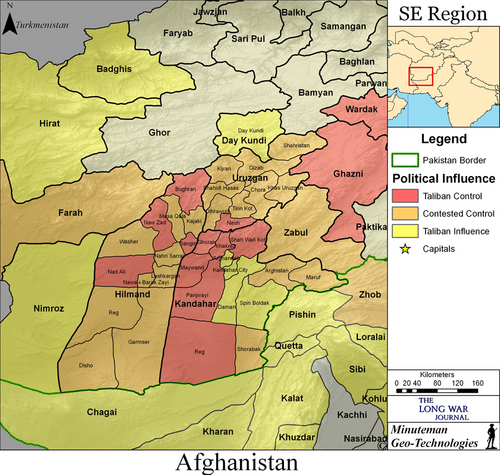 |
| Click map for full view. Taliban presence, by district, in Kandahar, Uruzgan, and Helmand provinces. Information on Taliban presence obtained from open source and derived by The Long War Journal based on the presence of Taliban shadow governments, levels of fighting, and statements from ISAF commanders. Map created by Bill Raymond for The Long War Journal. Last updated May 26, 2009. |
As Afghan and US forces complete an operation that targeted a Taliban stronghold in northern Helmand province, another area is identified as a Taliban safe haven that hosts al Qaeda training camps.
The Baghran district in northern Helmand hosts several camps run by al Qaeda's paramilitary Shadow Army, several military and civilian sources told The Long War Journal. Hundreds of Taliban and al Qaeda fighters have rotated through the Baghran camps. The Shadow Army, or the Lashkar al Zil, is al Qaeda?"s paramilitary force that closely operates with the Taliban and other jihadi groups in Afghanistan and Pakistan [see LWJ report, Al Qaeda's paramilitary 'Shadow Army'].
The trained fighters are then sent to conduct operations against Afghan and Coalition forces in Uruzgan and Kandahar provinces. "Some relatively well-trained Talibs come out of these camps," an intelligence official said. "They are trained to operate in small units, and expertise on IED [improvised explosive devices or roadside bombs] and suicide attacks are passed on to some fighters."
Some of the complex attacks in Kandahar and Uruzgan are thought to have been carried out by fighters trained at the Baghran camps, including the Feb. 2 suicide attack inside a training center for police reservists in the town of Tarin Kot in Uruzgan province. Twenty-one Afghan police were killed and seven more were wounded in the suicide attack.
Baghran, the northernmost district in Helmand, is located in a remote and mountainous region, and serves as an ideal sanctuary for the Taliban and al Qaeda operating in southern Afghanistan. There are no Coalition forces present and the region is largely unpatrolled.
The district was the scene of a major US airstrike in August 2007 that targeted what the US military called a "sizable meeting of senior Taliban commanders." Hundreds of Taliban fighters and leaders were said to be gathering in a village in Baghran to conduct a public execution of two "spies."
Mullah Dadullah Mansour, at the time the military commander in the south, and Mullah Abdul Rahim, a senior commander in Helmand who operates from Pakistan, were both reportedly in attendance. Both leaders survived the strike. Locals claimed that more than 50 civilians were wounded but the US military maintained that only Taliban fighters were killed or wounded.
Nearby Nad Ali district also an al Qaeda and Taliban stronghold
The district of Nad Ali in Helmand also serves as a safe haven for the Taliban and al Qaeda and hosts camps for the Shadow Army.
In that district, Afghan and Coalition forces recently completed a four-day operation in the village of Marja, which was described by the US military as a "key militant and criminal operations and narcotics hub in southern Afghanistan" and "a main command node." According to Quqnoos, an English-language Afghan news outlet, Marja has been under Taliban control for more than a year and a half [see LWJ report, Afghan and US forces battle Taliban in northern Helmand stronghold].
The military said more than 60 Taliban fighters were killed during the operation as the Taliban "mounted an ineffective and uncoordinated defense" of the village. No Afghan or US troops were reported killed during the fighting, and more than 223 tons of narcotics and 37 tons of materials used to make explosives were seized.
Afghan and Coalition forces cordoned the town's main bazaar, where Taliban command and control centers and narcotics and bomb factories were located, and then called in airstrikes to destroy the buildings.
US and Afghan military officers deemed the operation a major success. "The commandos thoroughly demolished a vital operational, logistical, and financial hub for the enemy and completed this mission victorious as the militants and criminals crawled away defeated and operationally-neutered," Ministry of Defense spokesperson Major General Mohammad Zahir Azimi said in a US military press release..
But Afghan and US forces did not remain in Marja to deny the Taliban and al Qaeda the opportunity to reestablish control of the region, according to a report in Quqnoos.
"The troops have left the area after the operation and the area is again under the control of the Taliban," said Daud Ahmadi, the spokesman for the governor of Helmand.
US Marines moving into Helmand in force
A US military officer said the raid in Marja is the best that can be done at this time because too few forces are available to secure all of the territory in southern Afghanistan.
"Until the additional troops are available, search and destroy operations like the one in Marja are the best we can do," the officer said. "The operation succeeded in its limited objective, and that command center needed to be taken out, but we won't make serious headway in the south until we can hold the ground in places like Marja."
This summer, the US will send an additional 17,000 troops to help stabilize the deteriorating security situation in Afghanistan. More than 8,000 Marines and 9,000 soldiers will be deployed to Afghanistan by this summer. The bulk of these troops will be deployed to the eastern and southern provinces where the Taliban control wide swaths of territory.
The fighting in Helmand is expected to intensify as the Marines from the 2nd Marine Expeditionary Brigade are deploying in the province and will also be operating in neighboring Farah province. The Marines have established two bases, Camp Dwyer and Camp Leatherneck, to support operations in the south.
Camp Dwyer is a forward operating base that will host the majority of the Marine forces. Leatherneck will host a battalion of Marines and the brigade's air combat element, which has more than 60 Harrier and Hornet attack aircraft, 12 Cobra attack helicopters, and more than 90 transport helicopters.
Al Qaeda Shadow Army camps located in northern Helmand
[Source: Good Times Society]

Al Qaeda Shadow Army camps located in northern Helmand
[Source: State News]

Al Qaeda Shadow Army camps located in northern Helmand
[Source: News Herald]

Al Qaeda Shadow Army camps located in northern Helmand
[Source: Cbs News]

Al Qaeda Shadow Army camps located in northern Helmand
[Source: Broadcasting News]
posted by 88879 @ 2:19 PM,
,
Coburn Will Run for Re-Election
PrintEmailPDF Sen. Tom Coburn (R-OK) announced he will seek another term in the Senate, Tulsa World reports.
Coburn Will Run for Re-Election
[Source: Good Times Society - by The American Illuminati]

Coburn Will Run for Re-Election
[Source: World News]

Coburn Will Run for Re-Election
[Source: International News]

Coburn Will Run for Re-Election
[Source: Cbs News]

Coburn Will Run for Re-Election
[Source: News Station]

Coburn Will Run for Re-Election
[Source: Wesh 2 News]

Coburn Will Run for Re-Election
[Source: Boston News]
posted by 88879 @ 12:58 PM,
,
Multimedia
Top Stories
Sponsored Links

Sponsored Links


